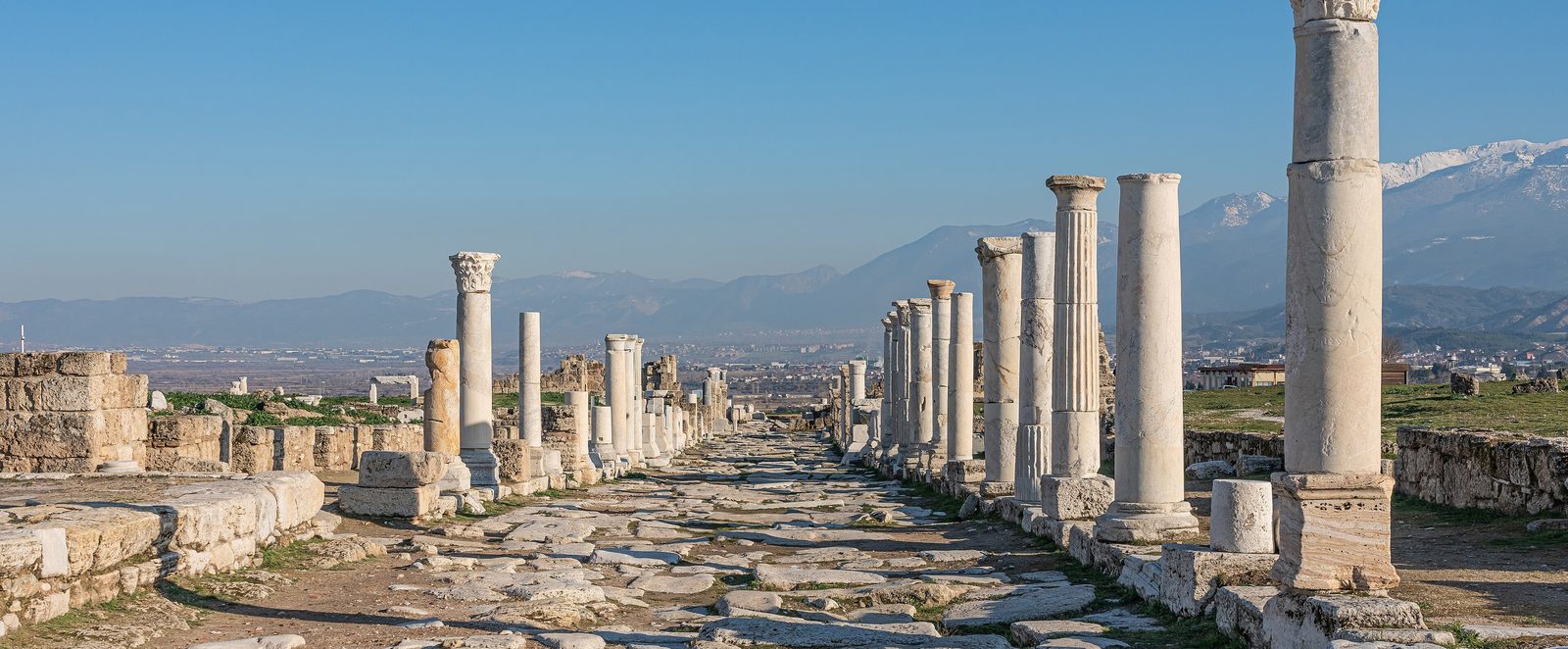
The church of Laodicea is the seventh and last of the seven churches of Revelation, addressed in Revelation 3:14–22. The excavated city lies about ten kilometers north of modern Denizli, across the valley from Pamukkale. The letter calls the wealthy congregation lukewarm — neither cold nor hot — and closes with the most famous image of all seven: a knock at the door.
We come to the seventh and last of the churches, the final stop on the circular road, and the recipient of the harshest letter of them all. Laodicea — the city of money and black wool — is told, in shocking language, that it makes Christ want to spit. And then, in a turn no one expects, the same letter ends with one of the tenderest invitations in the entire New Testament: "Behold, I stand at the door, and knock."
There is something fitting in the Apocalypse closing its round of letters not with a persecuted church or a heretical one, but with a comfortable one. The book ends its seven messages with a warning to a successful congregation.
A Rich City at the Crossroads
Laodicea was founded around the middle of the third century BC and named for a Seleucid queen. It sat in the Lycus valley where major roads crossed — the routes from Ephesus to the interior, from the Aegean to the southern coast — and that crossroads location made it, by the first century, immensely rich. Cicero mentions it as one of the great banking centers of the eastern empire; senators and traders changed their money here.
The proof of its wealth came in AD 60, when a major earthquake levelled the city. Other towns took imperial subsidies to rebuild. Laodicea refused them and rebuilt with its own resources — it was wealthy enough not to need help. That proud independence became, almost word for word, the city's self-image: we have need of nothing. Remember that phrase. The letter throws it straight back.

Three Industries, Three Rebukes
Three things made Laodicea rich, and the letter names all three.
First, banking — the refined gold that built its reputation. Second, wool — the city was famous across the empire for a soft, glossy black wool, and its fine garments were a brand. Third, eye medicine — Laodicea had a noted medical school and exported a celebrated eye-salve made from Phrygian powder.
Now read the counsel of the letter: "I counsel thee to buy of me gold tried in the fire, that thou mayest be rich; and white raiment, that thou mayest be clothed... and anoint thine eyes with eyesalve, that thou mayest see." Gold, clothing, eye-salve — the city's own three products, named one by one, and to each the same verdict: yours is fake; the real version comes from me. Your gold is unrefined; buy gold tried in fire. Your famous black wool cannot clothe your shame; buy white raiment. Your eye-salve cannot cure your blindness; buy sight.

The Water
And then the most famous image of all, which only makes full sense on the ground. Laodicea had no good water of its own. It sat on a flat tableland with the rivers running far below, and it piped water in over six or seven kilometers of stone channel from a distant spring. By the time that water arrived, it had warmed in the sun and thickened with minerals — lukewarm. You can still see the calcium crust inside the surviving pipes today.
The geography sharpens it further. Just across the valley to the north lay Hierapolis — modern Pamukkale, a UNESCO World Heritage Site — with its famous hot, healing thermal springs. Up the valley to the east lay Colossae, with cold, fresh mountain water. Hot water heals; cold water refreshes; both are good. Laodicea's water, having traveled hours in a hot pipe, was neither — tepid, mineral-heavy, the kind of mouthful you want to spit out.

I would thou wert cold or hot. So then because thou art lukewarm, and neither cold nor hot, I will spue thee out of my mouth.
It is not an abstract moral metaphor. It is the local tap water. Every Laodicean knew exactly what lukewarm tasted like, and exactly what you did with it. A spiritually lukewarm church is one that heals nothing and refreshes nothing — useful for nothing, just there. And this, we think, is the most relevant diagnosis of all seven for our own time. Most of us are not in spectacular danger. We are not Smyrna under threat, or Pergamon under the sword. We are mostly Laodicea: comfortable, self-sufficient, tepid.
"We Have Need of Nothing"
The letter then quotes the city's own civic pride and turns it inside out: "Because thou sayest, I am rich, and increased with goods, and have need of nothing; and knowest not that thou art wretched, and miserable, and poor, and blind, and naked." Five words, each the exact opposite of the local self-image — wretched against proud, poor against rich, blind in the city of eye-salve, naked in the city of fine wool. The city's confidence was its blindness.

The Surprising Tenderness
And then everything softens. "As many as I love, I rebuke and chasten." The harshness was never hatred — it was the bluntness of a doctor who has not given up on the patient. The doctor who only delivers good news may be the one who has stopped trying. The sharpness of the whole Apocalypse is rooted, in the end, in love.
Which brings the most famous sentence in all seven letters: "Behold, I stand at the door, and knock: if any man hear my voice, and open the door, I will come in to him, and will sup with him, and he with me." Feel the local weight of it. This is the city that boasted it needed nothing; its doors were comfortably shut, its dinner served, its household content. And Christ is pictured outside — on the doorstep of his own people, knocking, asking to be let in. In the city that has everything, he does not have a seat at the table.
But the promise is intimate. I will sup with him. Not a grand banquet — a quiet evening meal, two friends at a table. Even for the lukewarm, comfortable church, the door can still be opened from the inside. The dinner is still possible. He is still on the porch.
From the Door to the Throne
The last of all seven promises is the highest: "To him that overcometh will I grant to sit with me in my throne." Not a crown, not white robes, not hidden manna — a seat on the throne itself. And it is striking that the most exalted promise is given to the most compromised church. That is the deep pattern of the Apocalypse: the deeper the disease, the higher the cure. From the outside of the door to the inside of the throne — the reversal could not be greater.

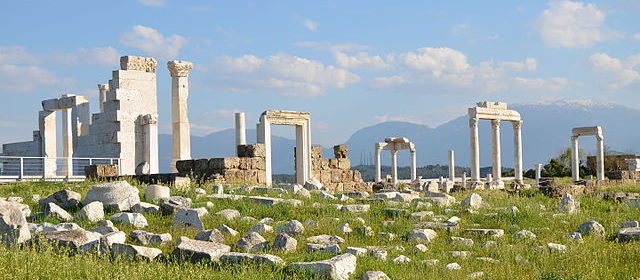
The site today — Laodicea on the Lycus, north of modern Denizli — is one of the most spectacular open-air excavations in Turkey, its marble streets and great buildings steadily rising again. The moment that always stops our groups is the stretch where the old water pipes lie beside the path, the white calcium crust still rough under your finger. Stand there on a quiet October morning, the cotton fields stretching to the ruined gate, Pamukkale gleaming white across the valley to the north and the green slopes of old Colossae to the east — the hot-water city and the cold-water city — and in between, on this windy plateau with its tepid pipes, Laodicea. The neighbors had what they needed. Laodicea had only its money. And even to it, the last and harshest letter ends not with a closing punishment but with an open invitation, still being offered to anyone quiet enough to hear the knock.
Laodicea Among the Seven Churches
Laodicea is the last stop on the circuit, inland in the Lycus valley about a hundred kilometers southeast of Philadelphia, from where the road bends back toward Ephesus and the coast. Among the seven it belongs with Ephesus and Sardis: all three were rich, established and self-assured, and all three were warned for it. The contrast with Smyrna and Philadelphia could hardly be sharper. Those two had almost nothing and were praised, while wealthy Laodicea boasted it needed nothing and received the harshest letter of the seven. It is fitting that the loop beginning at Ephesus, the church that lost its first love, ends here, at the church that had grown lukewarm.
Gallery


Sources & Further Reading
- Laodicea on the Lycus — Wikipedia — the history and excavation of the site
- Hierapolis–Pamukkale — UNESCO World Heritage Centre — the hot-spring city across the valley
- Revelation 3:14–22 (KJV) — the letter to Laodicea
- Cicero — Wikipedia — the Roman witness to Laodicea’s banking wealth