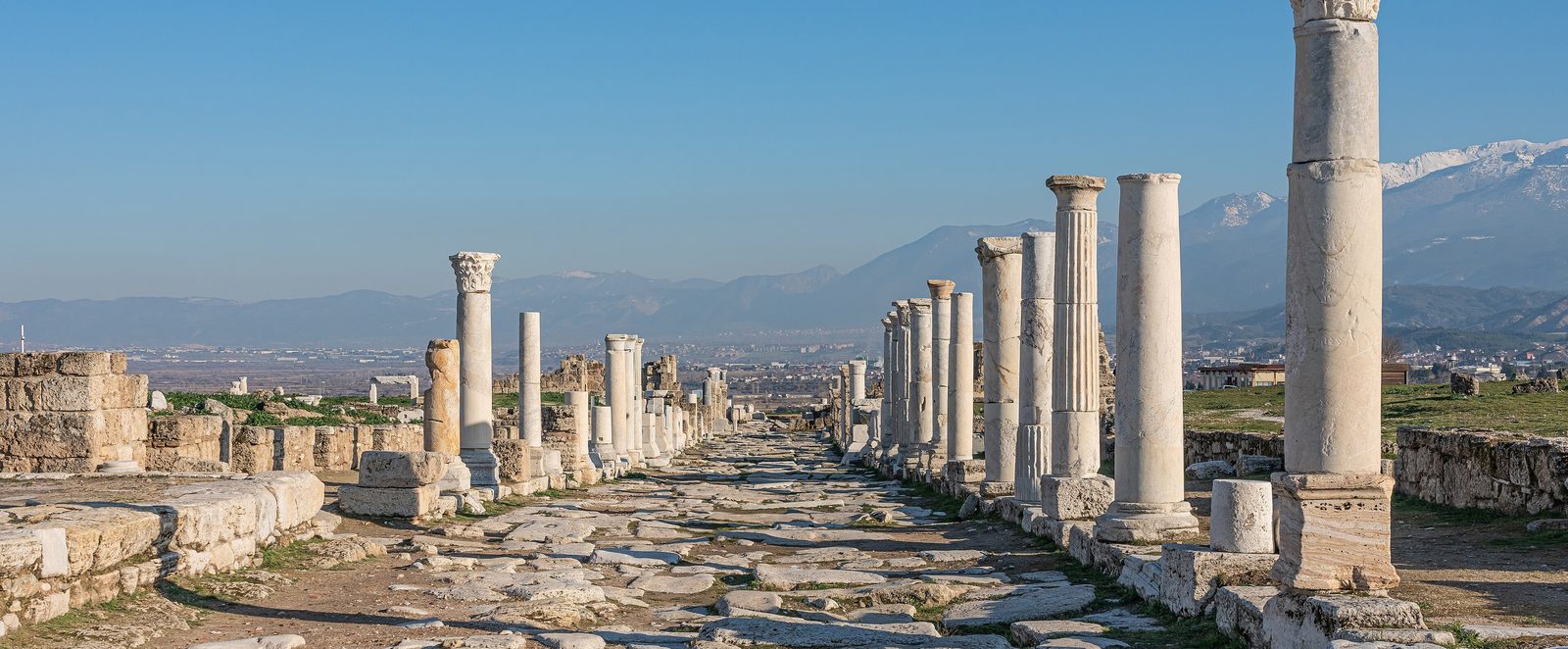
The church of Smyrna is the second of the seven churches of Revelation, addressed in Revelation 2:8–11. Ancient Smyrna lies beneath modern İzmir, Turkey’s third-largest city — the only one of the seven cities never to have died. Smyrna is one of just two churches to receive no rebuke, and is promised the crown of life. Gezginol Tours, a TÜRSAB-licensed travel agency in Kuşadası beside Ephesus, guides the Smyrna agora and the wider Seven Churches route with priority-pass entry; site tickets are paid separately, at cost.
Of the seven cities of the Apocalypse, Smyrna is the only one that never died. The others fell into ruin and silence. Smyrna is alive under your feet — it is modern İzmir, the third-largest city in Turkey, more than four million people living on top of the ancient one. To visit Smyrna is to look for the ancient city in the gaps of a busy modern one, which is exactly the right way to meet a church whose letter is about death and life.
A City That Had Already Risen
Smyrna's history gave it a strange and fitting self-image. The old city was destroyed around 600 BC by the Lydian king Alyattes, and for roughly three centuries the place lay nearly empty. Then, around 300 BC, it was refounded on a new site — and the local Greek tradition spoke of this refounding as the resurrection of Smyrna. A city that had died and come back. Hold on to that idea; the letter turns on it.
It was a beautiful and proud place. The geographer Strabo called it the loveliest city in Asia. Along the top of Mount Pagos ran a ring of fine public buildings that the citizens called the Stephanos Smyrnaion — the Crown of Smyrna. The city wore its skyline like a wreath, and it was proud of it.

What Survives
The most visible piece of ancient Smyrna is the agora, excavated in the heart of modern İzmir, with its colonnaded basilica and vaulted lower level still standing among the apartment blocks and bazaar streets. Above it rises Kadifekale, the citadel hill — the old Mount Pagos — from which the whole sweep of the gulf opens out. The city's most famous Christian, the bishop Polycarp, is remembered by a church that still bears his name in the modern street grid.

The Letter: Poor, but Rich
Smyrna receives one of the two shortest letters, and one of only two that contain no rebuke at all. Christ has nothing to correct here — only to comfort. He opens by naming himself "the first and the last, which was dead, and is alive." To a city whose own legend was death and resurrection, that is the most reassuring possible introduction: the very pattern you tell about yourselves is the pattern of the one who is writing to you.
Then comes a sentence with a hinge in the middle: "I know thy works, and tribulation, and poverty (but thou art rich)." The Christians of Smyrna were genuinely poor. They were small-business people, slaves, freedmen — near the bottom of the social ladder in a wealthy port, while the local elite and a prosperous synagogue community stood well above them. But thou art rich. Not in secret money — in the things the surrounding wealth did not have. Faith, fellowship, hope. A poor congregation that was, in the deepest ledger, the rich one.
What Is the Synagogue of Satan in Revelation 2:9?
In Revelation 2:9, the "synagogue of Satan" is a rebuke aimed at one local group in Smyrna that was slandering the small Christian community there, very likely by informing on it to the Roman authorities. Satan means "adversary" or "accuser" in Hebrew, and accusing is what the verse describes. It is not a verdict on the Jewish people.
The letter also speaks of "them which say they are Jews, and are not, but are the synagogue of Satan." We always stop and handle this line with care, because it has been cruelly misused for centuries as if it condemned the Jewish people. It does no such thing, and reading it that way gets the history exactly backwards.
The first Christians of Smyrna were themselves Jews — Jews who had accepted Jesus as Messiah, still thinking of themselves as part of the wider Jewish community. The phrase points to a specific, local, painful event: some members of the local synagogue had begun denouncing the Christian Jews to the Roman authorities. As long as Christians counted as Jews, they shared the legal exemption from the imperial cult; once they were formally declared not Jews, that protection fell away and they became liable to arrest. The line is the language of comfort to a small community that had been informed on by its own former neighbors — not a verdict on a people. We owe it to those actual Smyrnaean Christians, who were Jewish themselves, to read it as they would have.
Two details in the text support that reading. The word the King James Version renders "blasphemy", blasphēmia in Greek, is the ordinary word for slander, damaging talk about a person, and many modern translations of this verse print "slander". And later in the same book Satan is named "the accuser of our brethren" (Revelation 12:10). The charge is about what was being said against the Christians, and to whom. The same hard phrase comes back in the letter to Philadelphia, and we read it there in the same careful, local way.
Ten Days, and a Crown
The letter does not promise that suffering will be avoided — only that it will be limited: "ye shall have tribulation ten days." In apocalyptic language, ten is a complete but bounded span, the way Daniel and his friends were tested for ten days in Babylon. This is, we think, one of the most pastorally useful lines in the whole book, because the worst part of any suffering is the fear that it will never end. The letter answers: it is real, but it has a limit. Endure it.
Be thou faithful unto death, and I will give thee a crown of life.
There is the central command, and the promise. The Greek phrase means all the way to the point of death — even if it costs your life. And the crown, stephanos, is the very word the city used for its own ring of marble buildings on the hilltop. Forget the crown of marble, Christ says. There is another crown. The crown of life.

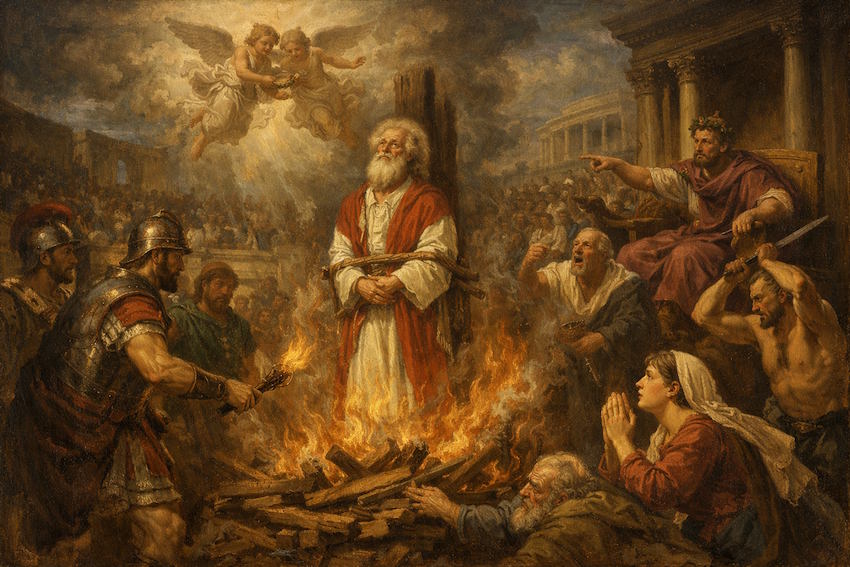
About sixty years after this letter, that promise was tested in the most literal way. Polycarp, by then an old bishop of about eighty-six, was arrested during a festival and brought to the stadium of his own city. The proconsul offered him the simple escape: curse Christ and go home. His answer has echoed ever since — "eighty and six years have I served him, and he hath done me no wrong; how then can I blaspheme my King who saved me?" He was burned in the arena, faithful unto death, and in the Christian understanding he received the crown the letter had promised six decades before. The community's own eyewitness account, the Martyrdom of Polycarp, still survives — the earliest detailed record of a martyrdom the Church possesses.
What Was the Crown of Smyrna?
The crown of Smyrna was the ring of porticoes and public buildings on the rounded top of Mount Pagos, today's Kadifekale above İzmir, that made the city's skyline look like a wreath. Revelation 2:10 sets another crown against it: "a crown of life" for the faithful.
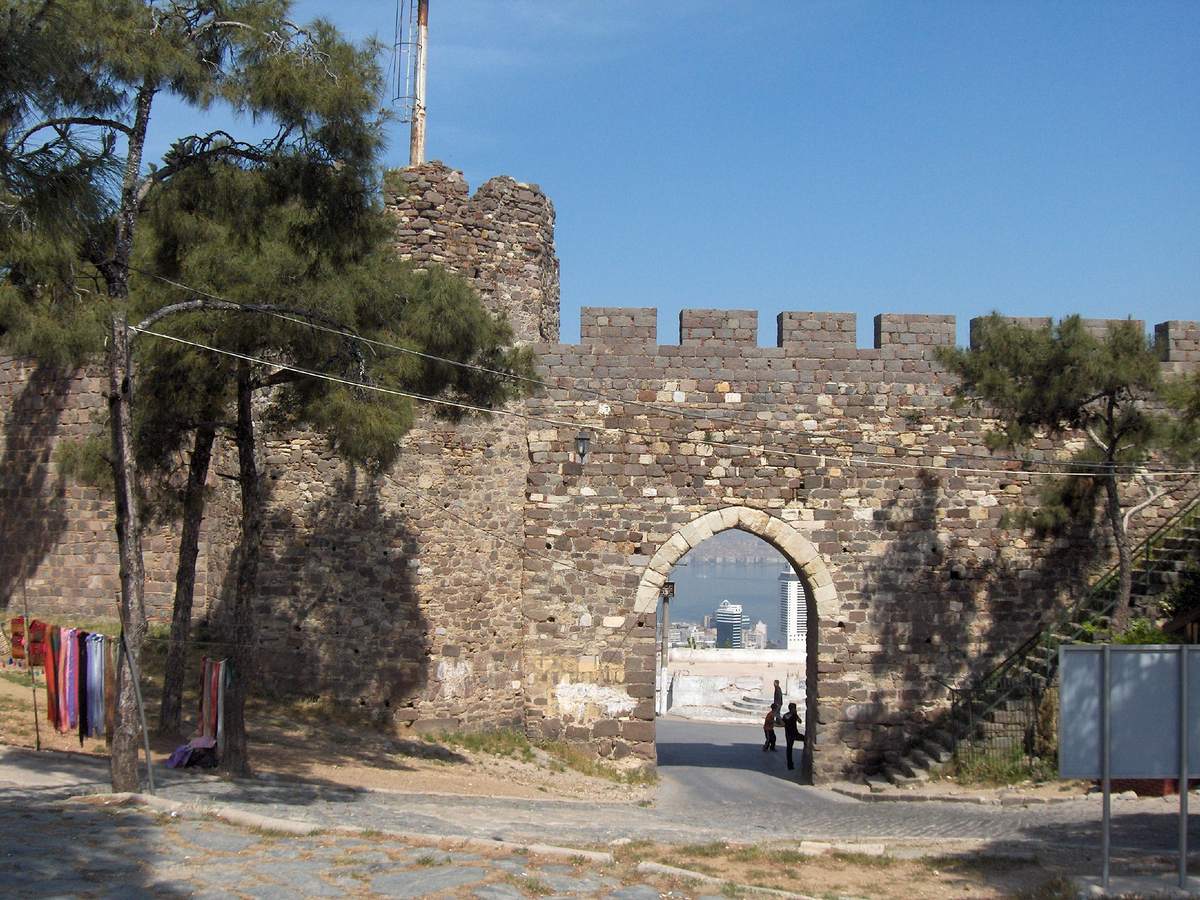
The phrase was a familiar one in the city. The philosopher Apollonius of Tyana, visiting Smyrna in the first century, told its citizens that it was better to wear a crown of men than a crown of porticoes and pictures and gold, and his biographer Philostratus kept the line. The Scottish scholar William Ramsay, who studied the seven cities more than a century ago, noticed that the letter makes the same move and leaves half of it unspoken: the citizens knew which crown they were proud of, and Christ offers them another.
The word itself matters. The crown of 2:10 is a stephanos, the wreath given to the winner at the games or to a citizen the city wished to honor, not the diadēma of a king. It is a crown received at the end, for finishing. The account of Polycarp's death, written by his own church, uses exactly that language: he was "crowned with the crown of immortality."
The hill is still there. Kadifekale rises 186 meters above the bay, straight over the agora, and the walls on its summit, first built by Lysimachus when the city was refounded and rebuilt many times since, still ring the top. From its gate you look down over the rooftops of İzmir to the water. On our four-day Seven Churches tour you see the hill from the agora of Smyrna on the first afternoon, where the letter is read aloud; we arrange priority entrance, and the agora ticket is paid separately, at cost.
The Second Death
The closing promise is unique among the seven: "He that overcometh shall not be hurt of the second death." The first death is the death of the body. The second death, named later in the book, is the final and eternal loss. To a community facing execution, this is the strongest answer imaginable: the empire can take your body — that is only the first death — but it cannot touch the deeper life that is held in another hand. The worst Rome could do was end a life. It could not reach the soul.
Stand in the agora of İzmir at dusk, with the noise of the living city pressing through the fence — the sellers calling, a café radio, the wind off the bay through the old columns — and read those four short verses. The city kept living. The promise still stands.
Smyrna Among the Seven Churches
Smyrna sits about eighty kilometers north of Ephesus and a hundred south of Pergamon, the middle of the three coastal cities before the road turns inland toward Thyatira and Sardis. Its closest kin among the seven is Philadelphia. These two alone receive praise with no rebuke, two faithful churches under pressure. It shares something darker with Pergamon, too, for both produced a famous martyr: Polycarp here and Antipas there. Set beside wealthy Ephesus, Sardis and Laodicea, poor Smyrna looks like the opposite case entirely, the church with the least that was told it was rich.
Gallery

Sources & Further Reading
- Revelation 2:8–11 (KJV) — the letter to Smyrna
- The Martyrdom of Polycarp — the earliest detailed martyrdom account the Church possesses
- Agora of Smyrna — Wikipedia — the excavated heart of the ancient city in İzmir
- Polycarp — Wikipedia — the life of Smyrna’s most famous Christian