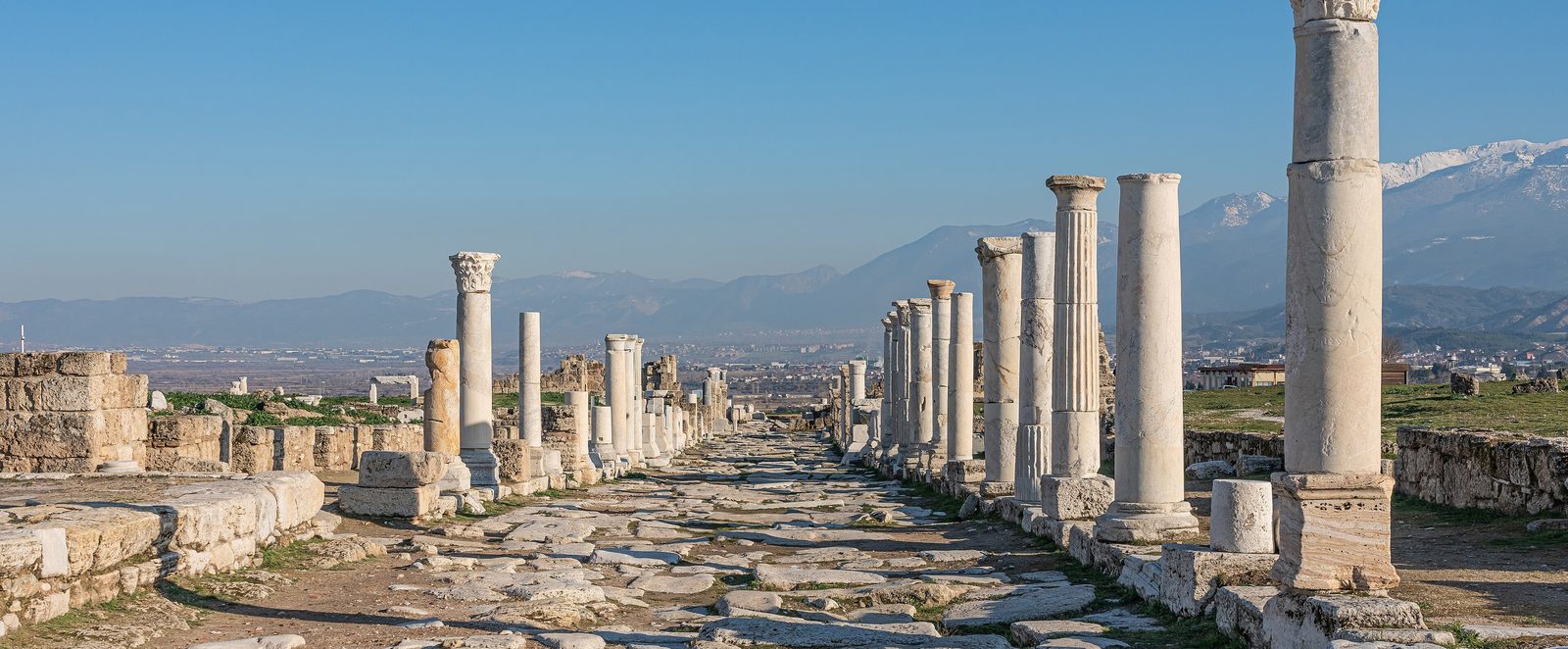
Near the beginning of the Book of Revelation, a voice tells the writer to put down what he sees and send it to seven specific addresses: "What thou seest, write in a book, and send it unto the seven churches which are in Asia; unto Ephesus, and unto Smyrna, and unto Pergamos, and unto Thyatira, and unto Sardis, and unto Philadelphia, and unto Laodicea." Every one of those seven places stood on the western edge of what is now Turkey, and every one of them can still be reached today by car in an afternoon's drive from the Aegean coast.
This guide comes from the team at Gezginol Tours, a licensed travel agency based in Kuşadası, the Aegean port just down the coast from the ruins of Ephesus. Our guides have spent years walking these seven sites, season after season, and the longer we do it the more convinced we become that the seven letters are not a riddle to be decoded but a set of letters to be read — slowly, in their own places, with the stones in front of you.

Seven Real Towns, Not Seven Symbols
The first thing to understand is that these were ordinary working towns. Ephesus was a great harbor metropolis. Smyrna was a proud port. Pergamon was a former royal capital. Thyatira was a town of trade guilds. Sardis lived off old glory. Philadelphia clung to a shaking hillside. Laodicea counted its money. They were not abstractions. They had water systems, markets, theaters, temples, and small Christian congregations meeting in private houses among everyone else.
That ordinariness matters, because each letter is full of local detail. Smyrna, a city that had been destroyed and rebuilt, hears from the one "which was dead, and is alive." Laodicea, whose drinking water arrived lukewarm through a long pipe, is told it is "neither cold nor hot." Sardis, twice captured in its history by an enemy who climbed the cliff while the guards slept, is told to "be watchful." The letters are tailored. They were written by someone who knew these towns from the inside.
Why Seven
There were more than seven churches in the Roman province of Asia. Colossae, Hierapolis, Troas, Miletus and others all had Christian communities. So why these seven, and why in this order?
The simplest answer, and we think the right one, is the road. If you start at Ephesus and travel north up the coast, then swing inland and come back down through the river valleys, the seven cities fall into a natural loop — the route a courier would take carrying a circular letter from one congregation to the next. The order is not a secret code. It is a postal route. The case was made on the ground more than a century ago by the Scottish scholar William Mitchell Ramsay, who traveled these roads himself, and it has convinced most readers since.
But seven is also the number of completeness in Hebrew thought, and the early readers would have felt that. Seven letters to seven churches stand in for the whole church — every kind of community, every kind of strength, every kind of failure. Read together, they are a mirror. Almost any congregation, in any century, can find itself somewhere in the seven.


The Shape of Each Letter
Once you have read one of the seven letters, you have the pattern for all of them. Each follows the same structure:
An address — "unto the angel of the church in..." — followed by a description of Christ drawn from the great opening vision of Revelation 1. The description is never random; it is chosen to fit the city it is sent to.
A line of recognition — "I know thy works" — and then praise for what the community has done well. Five of the seven receive praise. Two of them, Smyrna and Philadelphia, receive only praise.
A rebuke, where there is one. Five churches are corrected. The faithful two are not.
A command — usually to remember, to repent, to wake up, or to hold fast — and often a warning about what will happen if they do not.
A closing promise to "him that overcometh," sealed with the refrain "He that hath an ear, let him hear what the Spirit saith unto the churches." The promises rise as the letters go: the tree of life, the crown of life, hidden manna, the morning star, the book of life, a pillar in the temple, and finally a seat on the throne itself.
How We Read Them
People sometimes arrive expecting the seven letters to predict the future — to map onto seven ages of history, or to hide a timetable for the end of the world. We gently steer away from that. The letters are sharper and more useful than any prediction. They are spiritual diagnoses of real communities, and the diagnoses still hold.
Ephesus had grown correct but cold. Smyrna was poor but rich. Pergamon was brave but compromised. Thyatira was loving but tolerant of the wrong thing. Sardis looked alive but was dead. Philadelphia was weak but faithful. Laodicea was comfortable and useless. Those seven conditions have not disappeared. They are walking around every city on earth right now, including this one.

The rest of this site takes the seven one at a time. For each, we have tried to do three things at once: describe the ancient city and what survives of it today, explain why the letter says what it says in that particular place, and draw out the meaning that still reaches us. A short set of background pieces sets the scene first — the island where the visions were written down, and the Roman world that pressed in on these little congregations from every side — and a handful of deeper essays follow the threads that run through all seven at once.
If you read nothing else, read the letters themselves first, in Revelation chapters 2 and 3. They take ten minutes. Everything here is only a companion to those two chapters, written by guides who have had the rare privilege of reading them, year after year, standing in the places where they first arrived.
Gallery

Sources & Further Reading
- Revelation 2–3 (KJV) — the seven letters themselves — read them first
- Seven churches of Asia — Wikipedia — an overview of the seven cities and their letters
- W. M. Ramsay, The Letters to the Seven Churches of Asia (1904) — the classic on-the-ground study of the seven cities
- Revelation to John — Encyclopaedia Britannica — a concise scholarly introduction to the book